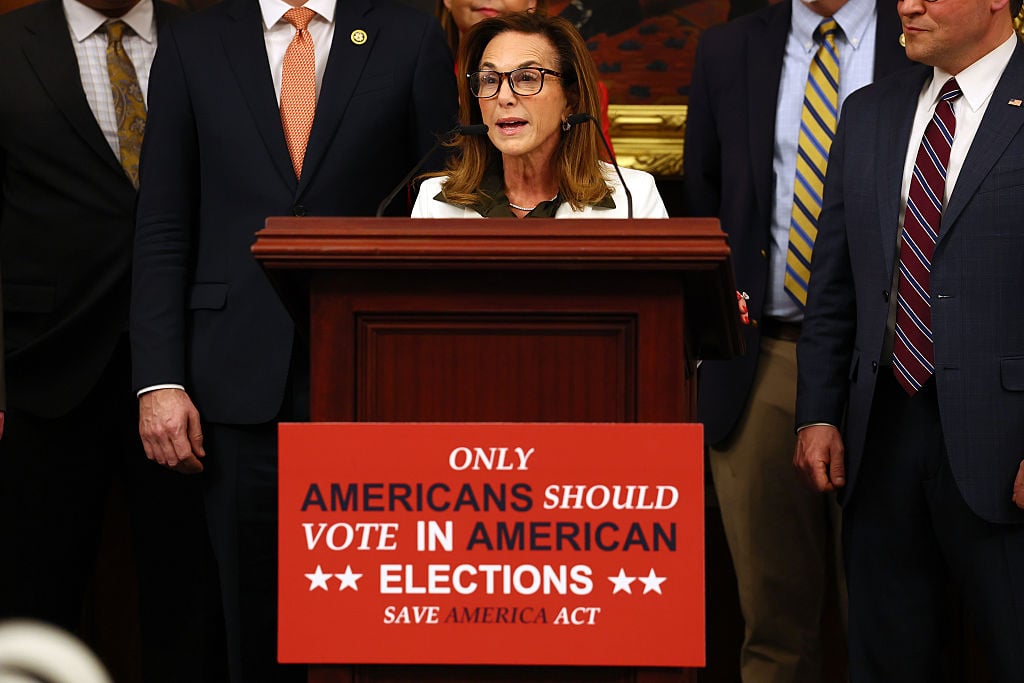
The House of Representatives has passed a proposal that would make it harder for tens of millions of Americans to vote by enacting strict and sometimes cumbersome voter ID requirements. While the current bill is unlikely to pass the Senate, it signals Republicans’ continuing efforts to pass restrictive voting legislation, a priority for the Trump administration.
House bill’s strict ID requirements could interfere with millions of eligible voters’ ability to vote
The House passed the Safeguard American Voter Eligibility (SAVE) Act on Wednesday, mostly along party lines. All House Republicans voted for the bill, as did one Democrat, Rep. Henry Cuellar of Texas, who President Donald Trump pardoned for corruption charges last year. All other House Democrats opposed the bill; a less stringent version of the act received support from four Democrats last year. The legislation would enact a set of highly restrictive new requirements for voter registration and voting. It would require proof of citizenship to register to vote, eliminate the option of registering to vote by mail, and require every state to require a photo ID for voting.
Experts warn that the bill would produce major voting difficulties for millions of Americans. An estimated 21 million Americans don’t have easy access to the proof of citizenship documents, such as a birth certificate or U.S. passport, that would be required to register under the act. Such a requirement disproportionately impacts younger voters and people of color. Additionally, people whose names don’t match their passports or birth certificates, including women who changed their names when they were married, could be delayed or prevented from registering. Experts also fear the power that the act would give to the federal government over elections, which are constitutionally run by the states. The act would impose a voter ID requirement on all states and require them to share voter information with the Department of Homeland Security.
Trump, allies divide GOP with push to control elections
The SAVE America Act has little chance of passing in the Senate. Senate Majority Leader John Thune, R-S.D., has already indicated that he won’t prevent a Democratic filibuster blocking the bill. Additionally, Sen. Lisa Murkowski, R-Alaska, has already stated her opposition to the bill, writing on social media, “Not only does the U.S. Constitution clearly provide states the authority to regulate the ‘times, places, and manner’ of holding federal elections, but one-size-fits-all mandates from Washington, D.C., seldom work in places like Alaska.” She added that enacting sweeping legislation like this close to Election Day “would negatively impact election integrity by forcing election officials to scramble to adhere to new policies likely without the necessary resources.”
Although the legislation may not pass, it signals the determination of the president and his allies to assert control over upcoming elections. Other loud conservative voices, such as billionaire Elon Musk, have also pushed the SAVE America Act. Earlier this month, Trump said that Republicans should push to “take over” and “nationalize the vote,” a stance that Democrats and some Republicans, including Thune, rejected. House Speaker Mike Johnson, R-La., in contrast, supported Trump’s baseless claims of widespread voter fraud in relation to the proposal to nationalize elections. Trump has taken other actions to influence upcoming votes, including this year’s midterm elections and potentially the 2028 presidential election as well. In 2025, Trump pushed Republican-led states like Texas to engage in partisan gerrymandering to increase their seats in the House, a move that set off a wave of GOP-led redistricting as well as retaliatory efforts by Democratic-led states like California to redraw their maps. Last month, the Trump administration sent the FBI and Director of National Intelligence Tulsi Gabbard to raid election offices in Georgia, part of Trump’s continuing push to investigate his 2020 election fraud claims that have already been repeatedly debunked.
Even if the SAVE America Act fails in the Senate, as is expected, it will likely not be the last effort by the Trump administration to influence the 2026 midterm election and future votes. The president seems determined to use his influence and the power of the federal government to push his election fraud conspiracy theories and to use those false claims to interfere with Americans’ ability to exercise their constitutional right to vote.