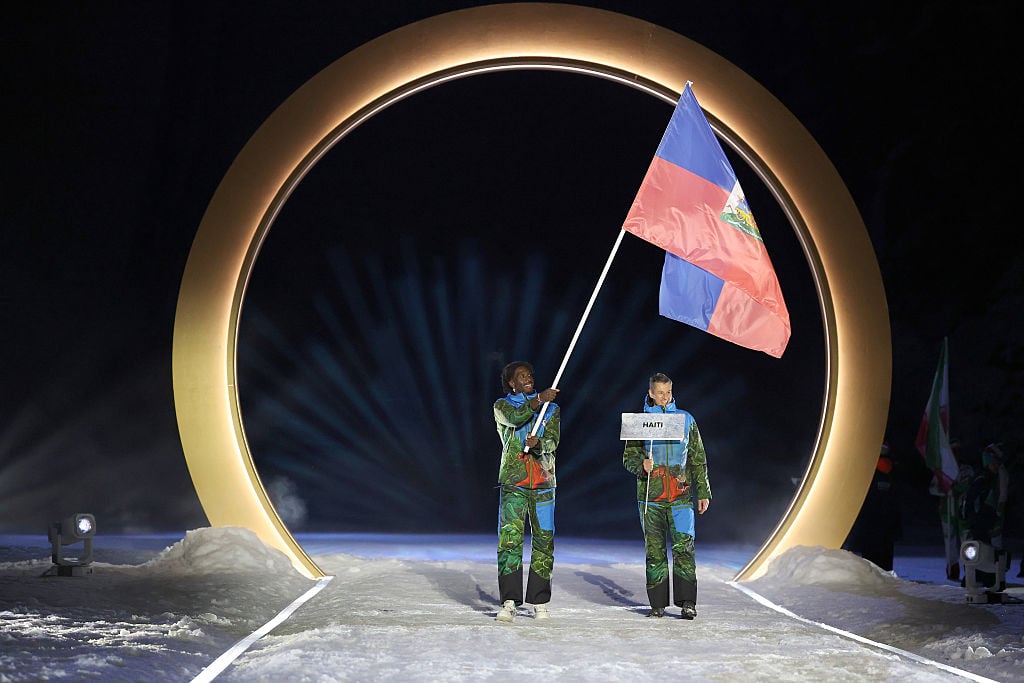
Haiti, a country not usually associated with winter sports, has sent a small team to participate in the 2026 Milan Cortina Winter Olympics. While the Haitian contingent is taking advantage of the rare opportunity to represent the country at the international sporting event, the team has been unable to pay respect to the man credited with the nation’s independence.
Representing Haiti’s history and the founding figure at the Olympics
The two-person Haitian team was informed that their uniforms couldn’t display an image of Toussaint L’Ouverture, the formerly enslaved man who became the leader of the revolutionary forces that fought for the country’s independence. L’Ouverture was eventually captured by French forces and died in 1803, the year before the independent Republic of Haiti was established, and he is generally revered as the country’s founding father. The two Haitian athletes competing in the 2026 Winter Olympics, both skiers, initially wore uniforms depicting L’Ouverture, based on a painting by Haitian artist Edouard Duval-Carrié of L’Ouverture riding a red horse. The International Olympic Committee, however, ruled that the image of Haiti’s founding father was a ‘political’ symbol and thus prohibited the athletes from wearing it.
The ruling left uniform designer Stella Jean with the task of representing Haiti’s revolutionary history without directly depicting its leading revolutionary.
“Rules are rules and must be respected, and that is what we have done,” Jean told The Associated Press concerning the uniform ruling. She followed the IOC’s ruling by depicting a riderless red horse on the skiers’ uniforms, along with the name “Haiti” depicted against a deep blue sky. “But for us, it is important that this horse, his horse, the general’s horse, remains,” Jean said. “For us, it remains the symbol of Haiti’s presence at the Olympics.”
Jean, who also designed the Haitian Olympic team’s uniforms for the 2024 Summer Games in Paris, also adorned women in the country’s Olympic delegation with outfits that featured nods to the country’s history, including a tignon, a Haitian turban once forced upon Haitian women to cover their hair.
Haiti’s Winter Olympic team serves as a bright spot amid turbulent years
Haiti has a long Olympic history, winning its last medal nearly a century ago in the 1928 long jump competition. Haiti first competed in the Winter Olympics in 2022, when skier Richardson Viano placed 34th in the men’s slalom event. Viano has returned to represent Haiti in the 2026 Games. Joining him this year is Stevenson Savart, who is competing as Haiti’s first Olympic cross-country skier.
“It’s an immense source of pride and great happiness to wear this outfit and we’re trying to be symbols for our small country, and give them hope,” Savart posted on social media, “because right now they are going through a rather dark period, so we’re trying to shine a light on small countries.”
Savart completed his first Olympic race Sunday, placing 64th in the skiathlon.
As Savart indicated, he and Viano are representing Haiti during a particularly trying moment in the country’s turbulent history. The 2021 assassination of Haitian President Jovenel Moise marked the beginning of a years-long political crisis, including a virtual collapse of the country’s national government and a proliferation of gang activity in the capital, Port-au-Prince, and elsewhere in the country. A major earthquake, mere weeks after the assassination, further devastated Haiti.
“It is a dream for me to be here and represent Haiti in a Winter Olympics for the first time,” Viano said when he first represented the country in 2022. “I hope this will show our country is about more than earthquakes and other disasters,” he declared at the time.
Four years later, Viano is again competing for Haiti in the Winter Olympics, with Savart joining him in the country’s delegation. Although the two athletes are unable to wear the image of the country’s founder on their uniforms, the two skiers are still intent on representing the country’s history and serving as present sources of joy in Haiti as the country seeks to rebound from political and natural disasters.